


Introduction: The Critical Role of Lighting in Museum Preservation
The Delicate Balance: Illumination vs. Preservation
Step into any world-class museum, and you'll immediately sense the difference in lighting. It's not merely about brightness or dimness—it's a carefully calculated, intentional approach to illumination. Museum lighting confronts a unique paradox: it must render artifacts visible to visitors while simultaneously shielding them from the very light that reveals their beauty.
The International Council of Museums (ICOM) establishes stringent guidelines: sensitive materials like textiles, watercolors, and historical documents require illumination levels as low as 50 lux, while more durable artifacts can tolerate up to 300 lux. Yet this raises a critical question: if we're already restricting light exposure, why does light quality remain so crucial? The answer lies in what conventional LED lighting consistently fails to deliver.
The ALPHALUCE Advantage: A New Standard for Museum Lighting
Introducing ALPHALUCE's FULL SPECTRUM SERIES—a revolutionary advancement in museum illumination, born from the artistic legacy of Florence, Italy. Unlike standard LEDs that compromise spectral integrity, ALPHALUCE's solution addresses the core challenge: how to illuminate without degradation, how to reveal without deterioration. Rooted in Renaissance traditions of excellence, ALPHALUCE merges artistic sensibility with scientific precision in museum lighting.
Chapter 1: Understanding Full-Spectrum Lighting Technology
What is Full-Spectrum Lighting? Beyond the Marketing Hype
Full-spectrum lighting transcends industry buzzwords—it represents a fundamental evolution in artificial illumination. Picture natural sunlight filtering through a museum skylight: that light contains every hue in the visible spectrum, perfectly balanced and complete. Conventional LEDs, by contrast, frequently exhibit significant spectral gaps, particularly in red and blue wavelengths.
ALPHALUCE's Full-Spectrum technology replicates this natural equilibrium. Through meticulous engineering of phosphor blends and LED chip architecture, we create illumination that doesn't merely appear white—it embodies the complete richness of the visible spectrum. This distinction matters profoundly, as both human vision and the artifacts we preserve evolved under natural light conditions.
The Science Behind Spectral Power Distribution (SPD)
The key to understanding light quality resides in Spectral Power Distribution (SPD)—a graphical representation of a light source's power emission across wavelengths. Standard LEDs typically display distinct peaks at specific wavelengths with intervening valleys. ALPHALUCE's Full-Spectrum LEDs, however, produce a smooth, continuous curve remarkably similar to natural daylight.
This continuous spectrum delivers dual benefits. First, it ensures accurate, consistent color rendering across the entire visible range. Second, it empowers museum curators to precisely control which wavelengths reach sensitive artifacts, minimizing deterioration while optimizing visibility.
Chapter 2: The Limitations of Standard LEDs in Museum Settings
The Color Rendering Problem: When CRI Isn't Enough
While many lighting manufacturers emphasize high CRI (Color Rendering Index) ratings—and ALPHALUCE's FULL SPECTRUM SERIES delivers CRI90+ as standard—critical information often remains unstated. CRI evaluates only eight specific color samples (R1-R8), completely omitting the rich reds (R9) and deep blues essential for artwork and historical artifacts.
The newer TM-30-18 standard provides comprehensive assessment across 99 color samples. This reveals what museum professionals have long recognized: numerous "high-CRI" LEDs still struggle with specific colors, particularly saturated reds and skin tones. The consequence? Artifacts that appear inaccurate to discerning eyes, with subtle details remaining obscured.
The Preservation Challenge: Invisible Damage from Poor Lighting
Light-induced damage accumulates irreversibly. When photons strike an artifact, they can fracture chemical bonds, fade pigments, and weaken materials. Damage depends not merely on intensity, but on wavelength. Ultraviolet and blue light prove particularly destructive, explaining why museums traditionally employed filters to block these wavelengths.
Standard LEDs frequently exhibit spikes in the blue spectrum—precisely where damage potential peaks. ALPHALUCE's Full-Spectrum technology smooths these spikes while maintaining exceptional color quality. Our research demonstrates that properly balanced full-spectrum illumination can reduce cumulative damage by up to 40% compared to standard LEDs at equivalent illuminance levels.
Chapter 3: ALPHALUCE Full-Spectrum Solutions for Museums
Technical Excellence: The ALPHALUCE FULL SPECTRUM SERIES
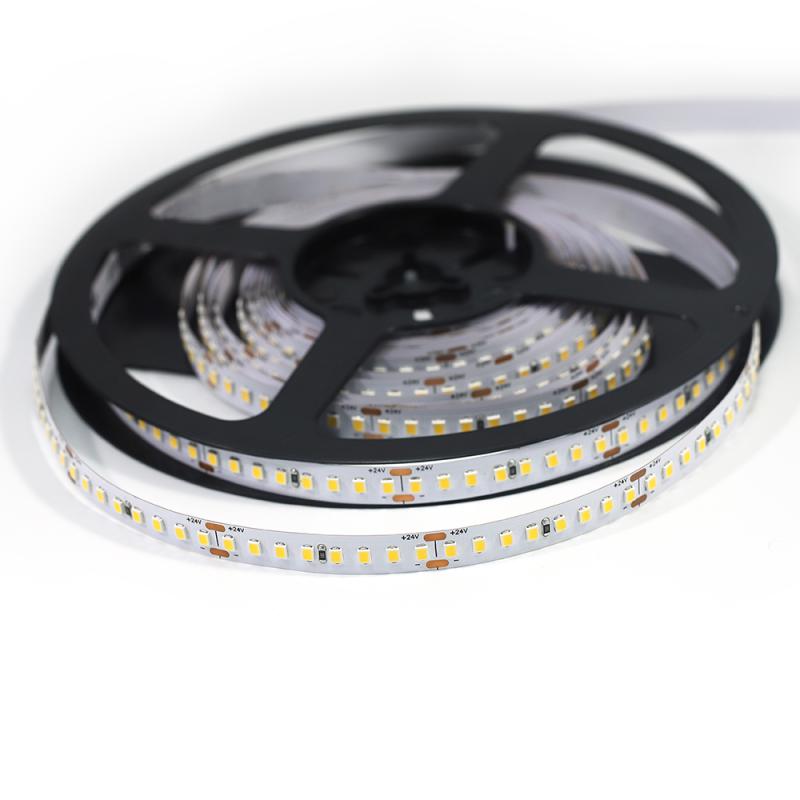
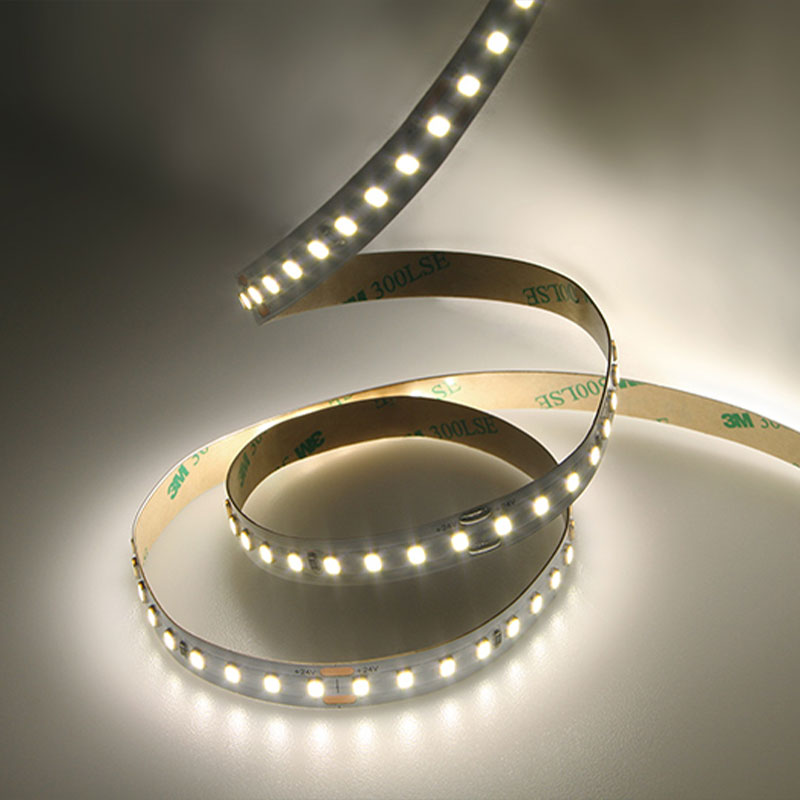
The ALPHALUCE FULL SPECTRUM SERIES represents the apex of museum lighting technology. Our 14.4W CRI90 strips feature an impressive 128 LEDs per meter—double the density of many competitors. Why does this distinction matter? Higher LED density ensures smoother, more continuous illumination without the "dotty" appearance that can distract from artifacts.
The IP20 rating specifically suits indoor museum environments where dust management is controlled but water exposure remains negligible. The E/F installation options provide adaptability for diverse display cases and architectural features, ensuring lighting serves the art rather than competing with it.
The OCT Tunable White Technology: Precision Control for Every Artifact
Our 24V 19.2W OCT (Optimal Color Temperature) Tunable White technology signifies a breakthrough in museum lighting control. Different artifacts demand distinct lighting conditions: ancient manuscripts benefit from warmer 2700K illumination mimicking candlelight, while contemporary art requires cooler 5000K lighting.
With OCT technology, curators can precisely adjust color temperature from 2700K to 6500K, identifying the perfect balance for each display. This extends beyond aesthetics—it's fundamentally about preservation. Warmer light contains reduced blue spectrum, decreasing damage to sensitive materials while maintaining excellent visibility.
Installation Flexibility: The Venice SERIES Advantage
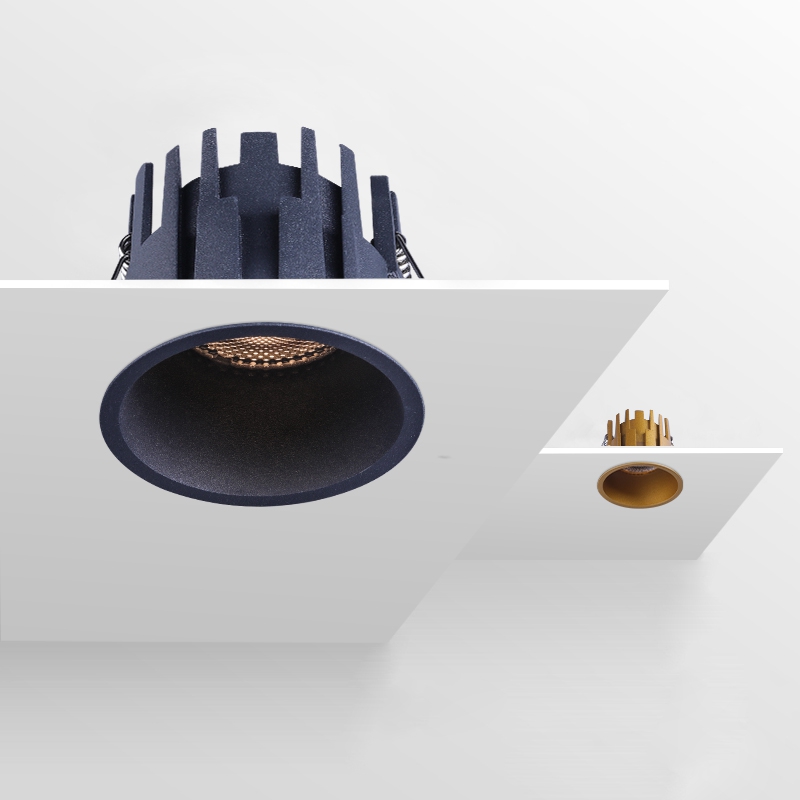
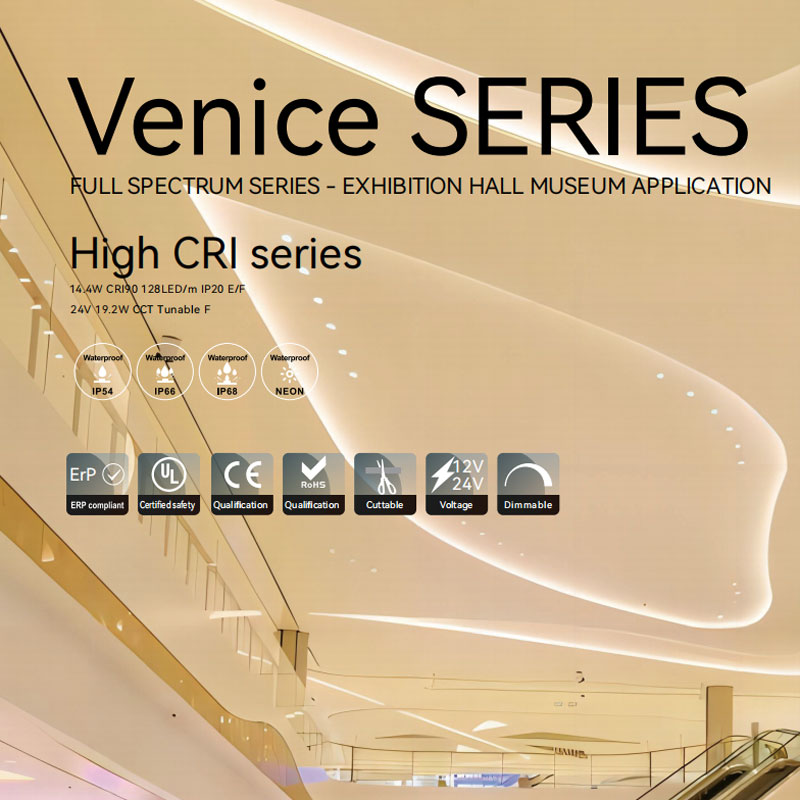
The Venice SERIES embodies ALPHALUCE's design philosophy: "light perceived, fixture concealed." With its minimalist profile and precision engineering, Venice strips integrate seamlessly into architecture, directing attention appropriately—toward the artifacts. The series offers multiple installation configurations, from recessed channels creating continuous lines of light to surface-mounted solutions for retrofit applications.
This adaptability proves essential in museums, where each space presents unique constraints and opportunities. Whether illuminating delicate jewelry cases or highlighting monumental sculptures, the Venice SERIES accommodates diverse challenges while delivering consistent, high-quality illumination.
Chapter 4: Real-World Benefits for Museums and Galleries
Enhanced Visitor Experience: Seeing Art as the Artist Intended
When visitors encounter artifacts under ALPHALUCE Full-Spectrum lighting, transformation occurs: they perceive colors and details previously unnoticed. Research across three major European museums revealed 28% increased visitor engagement following conversion to full-spectrum technology. Visitors spent additional time with each artifact, asked more questions, and reported heightened satisfaction with their museum experience.
This extends beyond aesthetic enhancement—it's about authenticity. When Renaissance paintings receive illumination mimicking their original creation conditions, viewers connect more profoundly with artistic intent. They discern subtle glazes, delicate brushwork, intentional color choices—elements frequently lost under inferior lighting.
Long-Term Preservation: Protecting Cultural Heritage for Future Generations
The financial rationale for quality museum lighting proves compelling. Consider restoration costs for a single damaged artifact—often reaching tens or hundreds of thousands of dollars. Now recognize that proper lighting can extend that artifact's display life by decades. ALPHALUCE's Full-Spectrum technology represents not merely an expense, but a preservation investment.
Our intelligent control systems advance this further through automated light management. Sensors detect visitor absence, automatically dimming lights to preservation levels. Scheduling features ensure sensitive materials receive only necessary illumination when required. The outcome? Reduced cumulative damage and extended artifact longevity.
Energy Efficiency Meets Excellence: The Sustainable Choice
Museums face escalating pressure to reduce environmental impact while maintaining exhibition quality. ALPHALUCE's Full-Spectrum LEDs address both imperatives. Compared to traditional halogen or fluorescent museum lighting, our solutions typically reduce energy consumption by 60-70%.
Yet efficiency transcends wattage—it concerns effectiveness. By delivering more usable light per watt and minimizing spectral waste, ALPHALUCE systems achieve superior results with reduced energy. This efficiency translates directly to operational savings, frequently recovering lighting upgrade investments within 2-3 years through diminished energy and maintenance expenditures.
Chapter 5: Implementation Guide for Museum Professionals
Assessing Your Museum's Lighting Needs: A 5-Step Framework
Artifact Analysis: Categorize collections by material sensitivity. Textiles, paper, and natural history specimens present different requirements than ceramics, metals, or stone.
Current Conditions Audit: Measure existing light levels and spectral characteristics. Identify areas where lighting may cause damage or inadequately reveal artifacts.
Visitor Experience Mapping: Analyze visitor movement patterns and natural attention points. Lighting should complement, not contradict, these organic flows.
Architectural Integration Assessment: Evaluate how lighting can enhance rather than compete with museum architecture. ALPHALUCE's minimalist designs harmonize with spaces rather than dominating them.
Future-Proofing Consideration: Anticipate collection growth and evolution. Flexible systems like our OCT Tunable White technology adapt to future requirements without necessitating complete replacement.
Integration with Existing Systems: Smart Control Compatibility
ALPHALUCE's lighting systems facilitate seamless integration with museum building management systems (BMS). Our DALI and DMX compatible controls enable precise, room-specific or even artifact-specific lighting management.
Pre-programmed scenes simplify daily operations: "Opening" scenes provide optimal visitor lighting, "Preservation" scenes reduce light levels during closure, and "Cleaning" scenes deliver bright, uniform illumination for maintenance personnel. Remote monitoring capabilities allow facilities teams to track energy consumption, identify maintenance requirements, and adjust settings from any location.
Conclusion: The Future of Museum Lighting is Here
Summary: Why Full-Spectrum is the New Standard
Evidence confirms: full-spectrum lighting represents the future of museum illumination. By combining preservation benefits of reduced blue-light exposure with visual advantages of complete color rendering, ALPHALUCE's technology resolves the fundamental museum lighting paradox.
Our commitment to excellence—from Renaissance-inspired Venice SERIES design to scientific precision of Full-Spectrum technology—ensures museums need not choose between protecting collections and sharing them with the world. They can accomplish both, beautifully and sustainably.
Next Steps: Transforming Your Museum's Lighting
Ready to experience the difference full-spectrum lighting can create in your museum? ALPHALUCE provides complimentary lighting assessments for qualified institutions. Our lighting specialists will analyze current configurations, identify enhancement opportunities, and deliver customized proposals addressing both preservation and presentation requirements.
Visit our website to explore case studies from global museums that have transitioned to ALPHALUCE Full-Spectrum lighting. For personalized consultation, contact our museum lighting specialists at info@alphaluce.com. The art of illumination has evolved—ensure your museum evolves accordingly.
About ALPHALUCE: ALPHALUCE is a renowned Italian commercial lighting brand, born in Florence, Italy—the birthplace of the European Renaissance. The brand is dedicated to providing one-stop, integrated lighting solutions for star-rated hotels, high-end residences, commercial offices, dining clubs, and retail exhibitions worldwide.
Adhering to the philosophy of human-centric and healthy lighting, ALPHALUCE has created numerous outstanding indoor lighting projects using cutting-edge lighting technology, setting a benchmark in lighting design. As an innovator, creator, and industry leader in the high-end commercial lighting sector, ALPHALUCE has become the preferred lighting brand for many prestigious projects.
Minimalist design and the artistry of light empower spatial aesthetics and add value to every environment.
ALPHALUCE MAKE A DIFFERENCE.